Slipping Stack Acceleration
MediumstaticsPhysElo Quiz #8Solved by 4
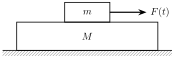
A small block of mass is placed on top of a long block of mass , which in turn rests on a frictionless horizontal floor. The coefficient of static friction between the two blocks is , and the coefficient of kinetic friction is , with . Initially, the system is at rest. A horizontal force , where is a positive constant and is time, is applied to the top block. Which of the following best describes the magnitude of the acceleration of the bottom block as a function of time?
Your answer
AIt increases linearly from zero, then abruptly drops to a lower positive constant value and remains constant.
BIt increases linearly from zero, then abruptly jumps to a higher positive constant value and remains constant.
CIt increases linearly from zero, then abruptly jumps to a higher value and continues to increase linearly with a steeper slope.
DIt increases linearly from zero, then abruptly drops to a lower value and continues to increase linearly with a shallower slope.
EIt remains zero until a threshold time, then abruptly jumps to a positive constant value.
to submit answers
Submissions are final
Solutions
05 attempted · 80% solve rateSolutions unlock when you solve
Be the first to write one — verified solvers only.