Tapered Capillary Tube
MediumfluidsPhysElo Quiz #9Solved by 8
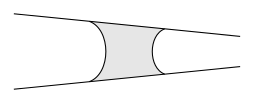
A small droplet of a completely wetting liquid (contact angle ) is placed inside a horizontal, open-ended glass tube. The tube is not uniform; it tapers gradually from a wider opening at the left to a narrower opening at the right. The droplet forms a single continuous slug of liquid that seals the tube, with two concave menisci exposed to the air.
Assuming the atmospheric pressure is constant throughout the tube, which of the following describes the initial motion of the droplet and the primary physical reason?
Your answer
AIt moves to the right, because the pressure inside the liquid is lower near the right meniscus.
BIt moves to the right, because the pressure inside the liquid is higher near the right meniscus.
CIt moves to the left, because the pressure inside the liquid is lower near the left meniscus.
DIt moves to the left, because the pressure inside the liquid is higher near the left meniscus.
EIt remains stationary, because the atmospheric pressure on the two outer surfaces is equal.
to submit answers
Submissions are final
Solutions
010 attempted · 80% solve rateSolutions unlock when you solve
Be the first to write one — verified solvers only.