Cascading Slip Thresholds
HarddynamicsPractice ProblemsSolved by 1
Two blocks, each of mass , are stacked on a horizontal floor. The static and kinetic coefficients of friction are and (with ) at both the block-block interface and the bottom-block-floor interface. Both blocks are initially at rest. A constant horizontal force is applied to the bottom block. Which of the following best describes the bottom block's acceleration as a function of , as is increased from zero?
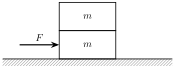
Your answer
AIncreases linearly from the origin with a single constant slope, with no discontinuities or kinks
BZero up to a threshold, then jumps discontinuously upward to a linear segment that continues with a single slope thereafter
CZero up to a threshold, then jumps discontinuously upward to a linear segment, then bends smoothly (no jump) to a steeper linear segment at a second threshold
DZero up to a threshold, then jumps discontinuously upward to a linear segment, then jumps discontinuously upward a second time to a steeper linear segment
EZero up to a threshold, then jumps discontinuously upward to a constant value and remains flat thereafter
to submit answers
Submissions are final
Solutions
01 attempted · 100% solve rateSolutions unlock when you solve
Be the first to write one — verified solvers only.