Force on a Shifting Axis
Mediumcircular motionPhysElo Quiz #4Solved by 3
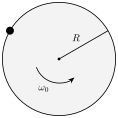
A uniform solid circular disk of mass and radius is on a flat, frictionless horizontal table. The center of the disk is initially at rest, and the disk is spinning with angular velocity about its center. A stone of equal mass , modeled as a point particle, is placed on the edge of the disk with zero initial velocity relative to the table. A rim built into the disk constrains the stone to slide, with friction, along the disk's edge; the contact between the stone and the disk's flat upper surface is frictionless. After the stone stops sliding with respect to the disk, the system rotates as a rigid body. What is the magnitude of the horizontal force exerted by the rim on the stone at this time? (Answer in terms of , , and .)
Solutions
03 attempted · 100% solve rateSolutions unlock when you solve
Be the first to write one — verified solvers only.